RUST BULLET® APPLICATION GUIDELINES
Rust Bullet’s Patented New Technology provides superior corrosion
control and protection.
To ensure you achieve the best possible results, it is extremely
important that these Application Guidelines are read thoroughly before
use. Unless specifically stated in these guidelines, the name Rust
Bullet applies to both Rust Bullet (Gold Label) and Rust Bullet Automotive
(Silver Label). Please refer to the most current Application Guidelines
available at www.RustBullet.com or by calling Rust Bullet Customer
Support at 800-245-1600.
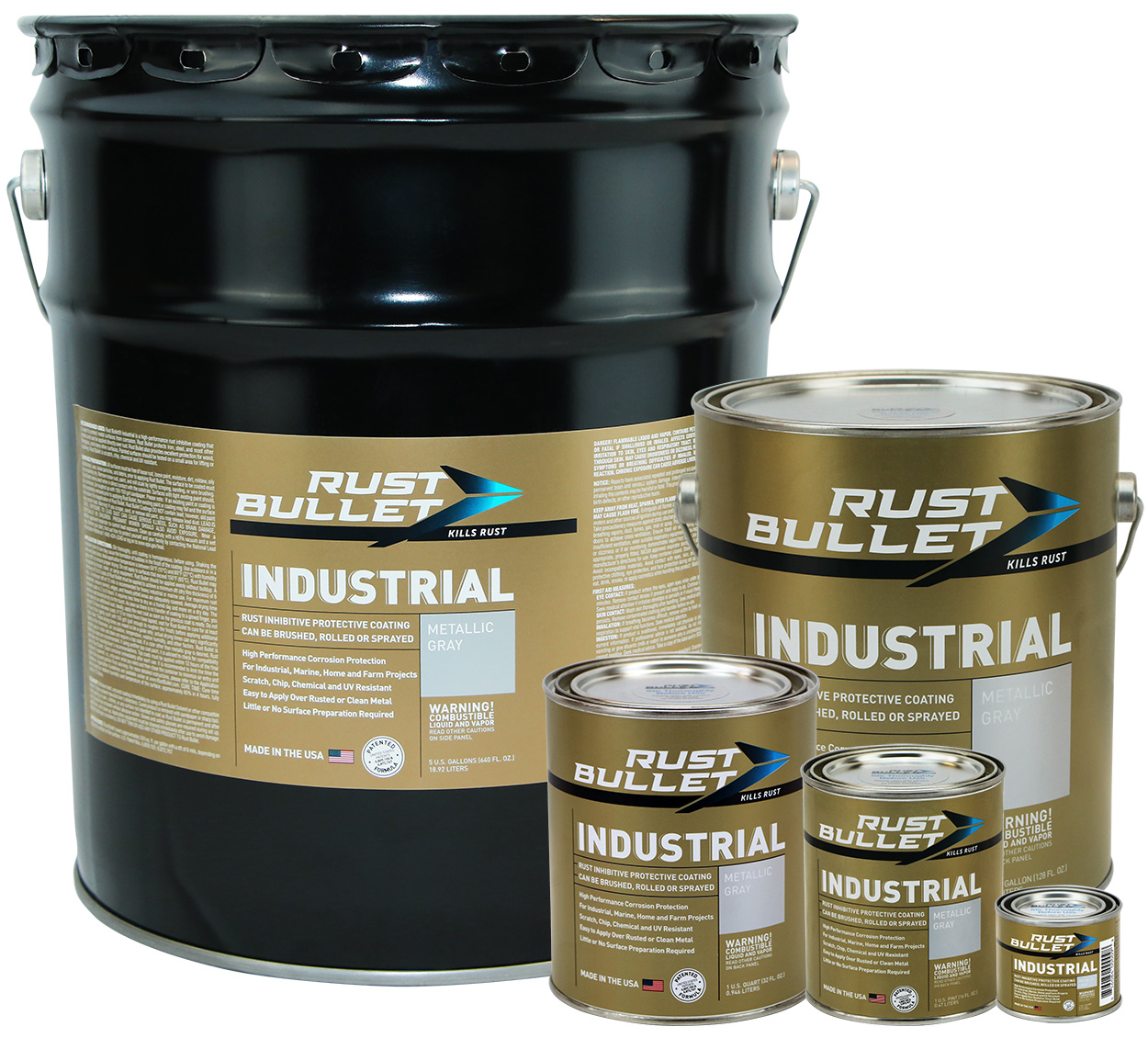
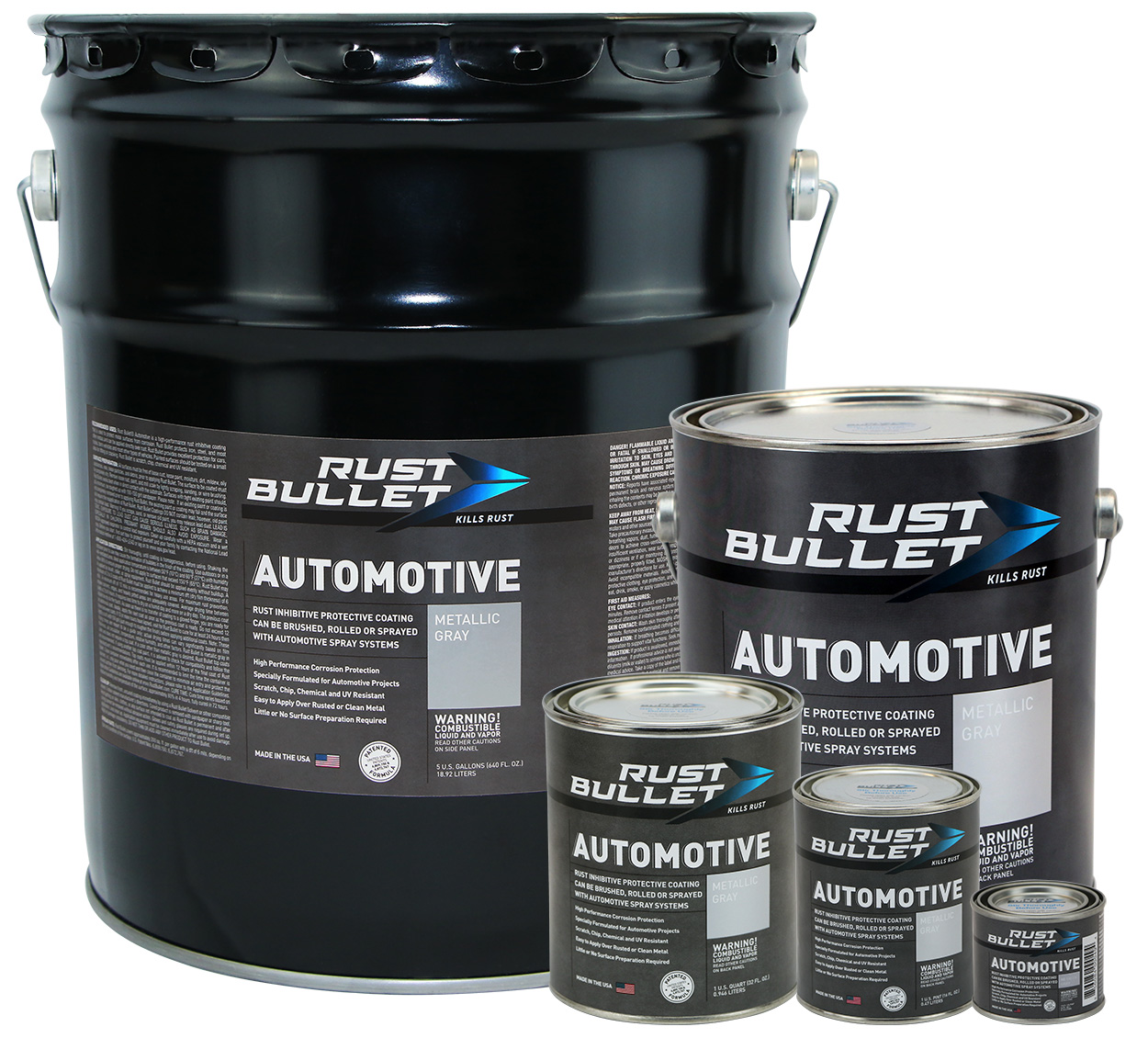
Rust Bullet®, Rust Bullet® Automotive, and Rust Bullet® BlackShell™ are
super-tough, high-performance, industrial grade, protective coatings.
Rust Bullet has been awarded an Unprecedented Two United States Patents
on its Two New Technologies in One Rust and Corrosion Control Product.
These advanced new technologies provide phenomenal adhesion resulting
in unsurpassed rust protection. Rust Bullet coatings provide outstanding
protection for iron, steel, aluminum and most other metals; as well
as, concrete, wood, fiberglass, and many other surfaces. Rust Bullet
coatings required little or NO surface preparation prior to application,
saving time, labor, and money. Rust Bullet coatings work best when
they are in direct contact with, rusted or clean, base metal or other
natural, uncoated surface. If a surface has an existing paint or coating
that can not easily be removed, simply rough up the painted surface
with 100-150 grit sandpaper or sanding sponge prior to applying Rust
Bullet or BlackShell. Painted surfaces should be tested on a small
area for lifting or cracking. Rust Bullet coatings provide outstanding
abrasion resistance, and are extremely resistant to acid splash and
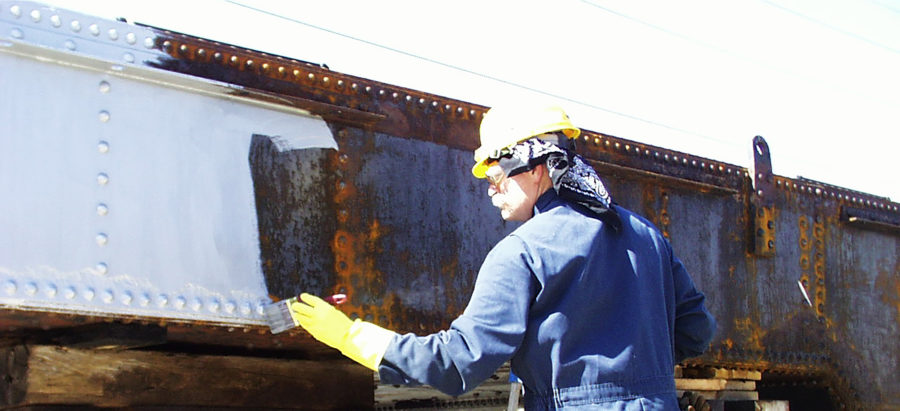
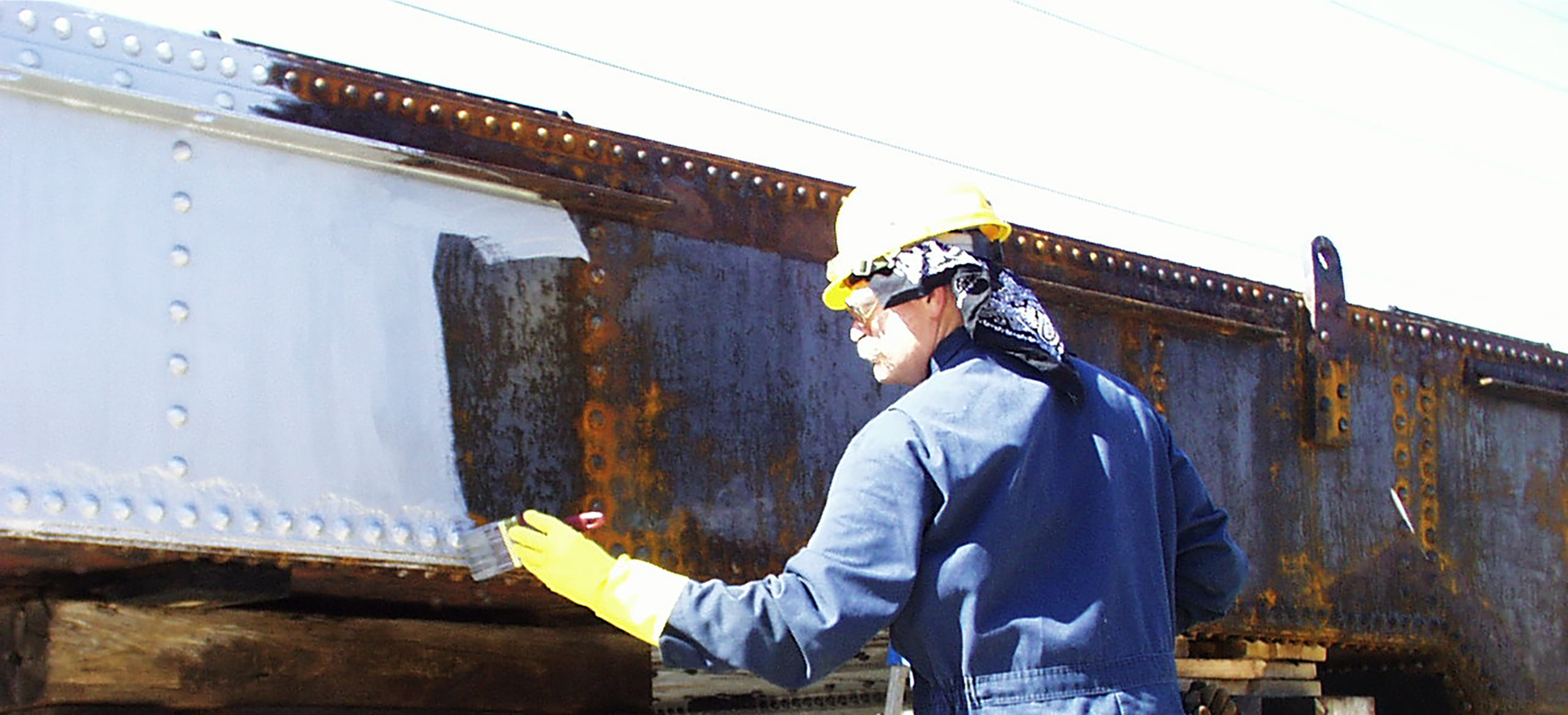
chemical solvents. Rust Bullet coatings may be applied by brush, roller,
or spray equipment. Apply evenly without buildup; use the crosshatch
method (up and down, side to side) whenever possible and appropriate.
Application equipment must be clean and free of moisture and all other
paint, especially latex, or paints containing alcohol. The surface
to be coated must be completely dry, any flakes of rust and paint should
be scraped or wire brushed off. Remove loose mill scale by lightly
scraping, sanding, or wire brushing. All surfaces must be free of loose
rust, moisture, dirt, mildew, oily substances, wax, loose paint, and
loose particles. It is important that the surface to be coated is completely
dry. Existing tight paint should be roughed up with 100-150 grit sand
paper or sanding sponge to insure proper adhesion. No additional surface
preparation is necessary; Rust Bullet Coatings have phenomenal adhesion
qualities that provide outstanding results with little or NO surface
preparation prior to application. IMPORTANT: Wear protective clothing,
gloves, and eye protection during set up, application, and clean up;
it is extremely tough to remove Rust Bullet or BlackShell from your
skin after about 20 minutes. Eye protection during application and
clean up is highly recommended. Rust Bullet covers approximately 400
square feet per gallon/per coat depending on the method of application
and the type and condition of the surface to be coated. It is critical
that at least two coats of Rust Bullet be applied to achieve a dry
film thickness of 6 mils (0.006 inches or 0.1524 millimeters). Additional
coats may be required to obtain the recommended dry film thickness
depending on the surface and method of application. For comparison
purposes, 4 mils is approximately the thickness of one sheet of standard
paper. It is particularly important that the first coat be generous
enough to soak through the rust to the steel or iron underneath. A
second coat of Rust Bullet must be applied to completely seal the first
coat; this cannot be done with any other paint or coating material.
BlackShell will cover approximately 400 square feet per gallon with
a one coat application (two coats are recommended when applying BlackShell
independently of Rust Bullet.). Optimum drying time between coats is
approximately two (2) to four (4) hours for Rust Bullet, and six (6)
to ten (10) hours for BlackShell, depending on humidity levels. Applying
Rust Bullet or BlackShell in overly thick coats could cause small bubbles
to form in the coating as it starts to cure; Carbon Dioxide gas is
released during the curing process and may become trapped in an overly
thick coat. Several thin coats applied in a crosshatch method (up and
down, side to side) will produce the best results. When applying additional
coats of Rust Bullet or BlackShell the previous coat should not be
wet or tacky; if you are unable to transfer the coating to a gloved
finger then it is safe to apply an additional coat. If the application
requires coating over existing paint or primers that can not be scraped
off, it is very important to rough up the surface with 100 to 150 grit
sand paper, sanding sponge or scuff pad prior to applying Rust Bullet
or BlackShell; this rule also applies to a previous coat of Rust Bullet
if 72 hours have lapsed between additional coats or the application
of a topcoat. For heavy industrial or marine use, a repeated coating
of Rust Bullet to achieve a total dry film thickness (DFT) of 12 mils
is required; an additional coat of BlackShell is recommended for industrial,
marine, or commercial top coat applications; any shortage of material
may limit the coatings’ effectiveness. For maximum rust prevention,
ensure corners, edges, and heavily pitted areas are adequately coated.
Rust Bullet requires no top coat; however, the final coat of Rust Bullet
may be topcoated after 24 hours with BlackShell or most conventional
topcoat paints following the manufacturer’s recommendations.
Cure time varies based on relative humidity and temperature of the
surface: Rust Bullet - 80% in 4 hours, BlackShell - 80% in 10 hours,
both coatings are fully cured in approximately 72 hours. When applying
Rust Bullet, it is recommended that the air or surface temperature
not be below 35oF (2°C) or above 110°F (43°C). Ideal application
temperature is between 50°F (10°C) and 80°F (27°C)
with humidity below 90% to ensure proper drying. Do not apply to surfaces
when the existing temperature of the surface exceeds 150°F (66°C)
or is below 32°F (0°C). After curing, Rust Bullet and BlackShell
have a service temperature range of 314°F (157°C) continuous,
and can tolerate temperature spikes of up to 700°F (371°C)
for up to 24 hour periods.
Immediately after use, spray equipment must be cleaned with Xylene
or Toluene. WARNING! If you scrape, sand, or remove old paint, you
may release lead dust. LEAD IS TOXIC. EXPOSURE TO LEAD DUST CAN CAUSE
SERIOUS ILLNESS, SUCH AS BRAIN DAMAGE, ESPECIALLY IN CHILDREN. PREGNANT
WOMEN SHOULD ALSO AVOID EXPOSURE. Wear a NIOSH-approved respirator
to control lead exposure. Clean up carefully with a HEPA vacuum and
a wet mop. Before you start, find out how to protect yourself and your
family by contacting the National Lead Information Hotline at 1-800-424-LEAD
or log on to www.epa.gov/lead.
PRODUCT STORAGE AND HANDLING
1. Care should be taken to ensure that new unopened containers
or left-over partial containers are kept sealed. Heavy Duty Plastic
Wrap can be placed over the top of the remaining coating with the
excess plastic exceeding beyond the rim of the container. This will
displace as much air as possible from the remaining coating and will
help prevent the lid from permanently sealing closed.
2. Rust Bullet and BlackShell are moisture sensitive. It
is recommended to limit the time the container is opened. Transfer
only the amount needed for the application of each coat. Immediately
wipe clean any coating from the rim of the container and reseal. This
should be done every time you use Rust Bullet or BlackShell and in
between coats. Never pour a Rust Bullet coating that has been exposed
to air and moisture back into the container.
3. If a skin has formed in a new unopened container or a
sealed container, remove by cutting edge of skin at the skin/container
surface. Discard the skin properly. Stir until uniform, filter if
necessary, and apply.
4. Rust Bullet coatings are packaged in unlined paint cans.
If for any reason the coating is transferred to another container,
clean, unlined, paint cans (or similar unlined metal containers) must
be used.
5. Unopened cans have a shelf life of at least two years
(previously opened cans: three to six months).
STIRRING
Do not open and stir Rust Bullet or BlackShell when the coating’s
temperature is below 32°F (0°C).
06/07 2
1. Since Rust Bullet and BlackShell are single-component
coatings, it is not necessary to mix “part A with part B”;
however, Rust Bullet and BlackShell must be stirred thoroughly before
using for at least 2 minutes or until completely uniform. (Avoid whipping
air into product.) Shaking the container prior to application may
cause the formation of bubbles in the finish of the coating.
2. Aged Rust Bullet or BlackShell (six months or older)
may develop settling. Follow the same process as in “STIRRING,
#1” but increase the stir time
and be sure to break up clumps on the bottom of the container,
if any.
3. Do not reduce or thin Rust Bullet or BlackShell. Do
not add other paints in an attempt to change the color of Rust Bullet.
Because of the
exacting chemical balance, thinning or altering will compromise
the quality of the cured product. Rust Bullet® Automotive (Silver
Label) is formulated
slightly thinner than Rust Bullet (Gold Label) and can
easily be sprayed through an HVLP, Automotive Finishing Gun.
EQUIPMENT SET-UP PROCEDURES
AIRLESS SPRAY: Rust Bullet®, (Gold Label), is
supplied ready to stir and apply with airless spray systems.
1. Inspect all spray equipment and ensure it is clean and
in good working order.
2. Flush Xylene or Toluene through your spray equipment (pump,
line, and sprayer) to remove any existing moisture or alcohol from
previous coatings or solvents.
Note: Do not re-circulate solvent through pump, as
the solvent will be contaminated with moisture and debris. Draw solvent
from one container and flush into another. Never allow old solvent
in the coating lines to enter a Rust Bullet coating.
3. Rust Bullet® (Gold Label) is formulated to work well with Airless
Spray Systems using a 517 or 519 tip, and an approximate 2400 psi.
4. Follow all stirring instructions as listed above under “STIRRING.”
Note: Ensure that minimum cure times are followed
for recoat. Published cure times (under normal weather conditions)
are recommended per coat as specified on the data sheet. When excessive
wet film is applied, additional cure time will be necessary.
CONVENTIONAL SPRAY: Procedures are the same as for
airless spray. Use only Xylene or Toluene for flushing equipment prior
to application and for clean up. If necessary, pour a small “float” of
Xylene or Toluene on top of the coating in the paint pot prior to sealing.
(Use only as much as is needed to just cover the surface). Do not agitate
in pressure pot. The float of solvent must not be mixed with the coating;
its only purpose is to keep air from coming into contact with the coating
in the paint pot for the duration of the application. Use standard
production type spray equipment. Air supply must have an effective
moisture trap. Use air pressure at the gun of 45-70 pounds. Use 15-20
psi pot pressure. Do not agitate in pressure pot. We recommend straining
through a nylon bag strainer. HVLP SPRAY: Rust Bullet® Automotive
(Silver Label) is formulated slightly thinner to flow smoothly through
HVLP automotive finishing guns and produces a finish comparable to
Powder Coating. It is best to use a gravity feed HVLP, 20-50 pounds
with a 1.4 to 1.5 tip. Three coats of Rust Bullet® Automotive should
be sprayed two to three hours apart using the HVLP system to achieve
the recommended dry film thickness. BlackShell can be applied with
either an airless spray system or HVLP. Note: When spray equipment
is idle for more than 15 minutes, it is necessary to resume painting
or flush with solvent. It may be necessary to lay tip of sprayer in
solvent to keep from curing. ROLLER OR BRUSH
APPLICATION: Use 1/4 to 3/8 inch nap synthetic fiber
roller cover for most applications. Pay special attention
when brush-applying Rust Bullet or BlackShell to prevent
brush stroke lines in the film. Rust Bullet coatings are self leveling.
When spraying, rolling, or brushing it is important to keep a wet
edge. Rust Bullet and BlackShell should be applied evenly
without buildup; use the crosshatch method whenever possible.
Applying overly thick, uneven coats could produce small bubbles
in the finished coating due to the carbon dioxide gas that is released
as the coating cures. For more specific application
information, please see our FAQ’s.
CLEAN-UP
1. Use Xylene or Toluene. Do not make assumptions about other
cleanup solvents without consulting Rust Bullet Customer Support.
Even a very small contamination of alcohol or other hydroxyl-containing
solvents can destroy the moisture-cure reaction, partly or entirely,
without any indication or jelling.
2. Always flush equipment clean. Do not leave residue as
it will harden and become insoluble in solvent. Clean equipment as
you would with any typical two component catalyzed coating. Always
clean brush or roller thoroughly or throw them away after use. Dunking
dirty equipment in solvent will not prevent the coating from curing.
Avoid contact with skin or clothing. Use gloves, safety glasses, and
other protective equipment. Any coating must be removed within 20
minutes or it will harden and become next to impossible to remove.
After drying, Rust Bullet and BlackShell can only be removed with
rigorous abrasive action. Rust Bullet or BlackShell that has dried
on the skin will wear off in about a week.
FINAL POINTS TO REMEMBER
1. Never allow rain, mist, sweat, or other contaminates to
fall into an open can of Rust Bullet or BlackShell; a plastic or cardboard
cover is always a good practice. Never apply Rust Bullet or BlackShell
while raining or under threat of rain.
2. When saving partial cans, lay a plastic sheet on
the remaining material then reseal. If a skin forms on the surface
of the material in the can, remove from the container and dispose of
properly. Stir until uniform. Strain if necessary.
3. Do not open the can until you are ready to use it.
4. Never over stir, entrap, or whip air into the coating.
5. For clean-up use only clean Xylene or Toluene. Never
allow lacquer thinner, vinyl thinner, epoxy solvent, or any alcohol
or unapproved solvent to enter the coating. Never neglect to purge
all paint, moisture, and debris from equipment before spraying. Spray
equipment must be cleaned immediately after use.
6. Applying a topcoat over Rust Bullet is not necessary;
if one is desired, please wait 24-48 hours after the application of
the final coat of Rust Bullet. BlackShell is designed as the optimal
top coat for use with Rust Bullet providing the ultimate rust protection.
BlackShell can also be used as a stand alone rust preventative, high
performance coating, providing excellent protection.
SAFETY CONSIDERATIONS
A certain degree of risk is involved in the use – or more properly,
the misuse, of most industrial materials. Rust Bullet coatings are
no exception to this rule. Ensure adequate ventilation and fresh air
when working with Rust Bullet coatings. Use a NIOSH Approved Respirator
with an 8051 Organic Vapor chemical cartridge and an R95 filter attached
with a filter cover. The NIOSH requirement is that the cartridge be
discarded at the end of a shift. Protective gloves and safety glasses
must also be worn. Due to the superior adhesive properties of Rust
Bullet coatings, we strongly recommend that protective clothing be
worn including long sleeves and a spray sock. It is critical to avoid
any conditions that may cause a fire. Avoid open flames, pilot lights,
sparks, heating elements, cigarettes, or any and all possible sources
of ignition. For more complete coverage of safety issues, see the MSDS
sheets at www.RustBullet.com.